Showing posts with label life drawing. Show all posts

Friday, October 14, 2011

Damn I Need to Blog

I got a whole bunch of work backed up now, which means I'm going to start posting more frequently. Maybe I'll get some of my street cred back.

Find a process for isolating elements of reality that leaves the prettiest artifacts. As in, the areas that aren't finished should look finished as quickly as possible. Constant time pressure helps you get better faster, because you begin to get rid of inefficiencies and you prioritize visual information so that the important stuff goes in first.

It's all about the bear necessities. Don't ask how many strokes it will take you, but ask how few. How few colours/values will it take to render a human body? What's important for you? Form? Pigment variation? Gesture? There are many ways to portray reality and none of them are "realistic" so choose to focus on a combination of visual elements that fits your brain.

Analyze the structure of  what you're drawing. That way your drawings will instinctively have more power, and you will learn more about your subject.

In entertainment design you can't stray too far from the zeitgeist. Your audience has to know and get what you're drawing right away.

When taking crits, always say "yes, and ..." If you don't understand, ask why.

Always keep in mind what the most important element in your design/painting is. ALWAYS. Before making any stroke, ask what is the important element.  I can't stress this enough.

Gradients give you more information that flat colours, however it's a lot harder to manage them to describe form.

Concept artists are basically prostitutes. You are hired to draw things without getting attached to any of them. I will probably return to this parallel.

The tighter the gradient, the harder edges you can use on your brush.

I repeat myself a lot, but that's only because these things are important. The easiest way to resist temptation is to give yourself no choice.

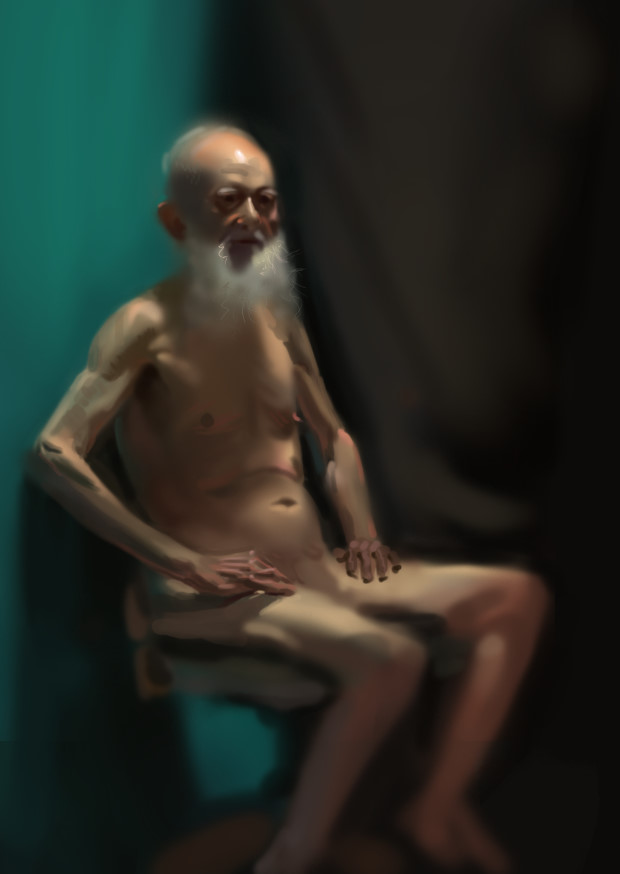
Life drawings from last night. 10s, 15, and 20s.


Wednesday, September 28, 2011

DEMACIAAA

I wanna get back to the age when I updated my blog so often that I ran out of titles. Unfortunately since then I've both slowed down in work I can show and expanded my title repertoire.

Because the game industry is so competitive, you have to be a genuinely good and nice person to get in. As a result, once you are in, you're surrounded by the brightest, nicest and quirkiest people you'll ever meet. I noticed when I moved to Riot that overall people seemed nicer, friendlier and smarter than most of the people I've met up to that point.

I already mentioned this on twitter, but it's very important so I'll reiterate: If you don't know what's wrong with your picture/design, use the process of elimination. Paint out every element, one by one, and eventually you'll know what doesn't belong. Picked that up from Maokai Xiao. The hard part is trying to figure out something to replace it.

Interrupt yourself frequently when not doing art. Do not interrupt yourself when doing it.

Separate silhouette from content.

The first difficulty with designing is making cool shapes. The next difficult is making them for a reason. You have to find a way to make shapes cool AND relate to the character/environment.

Here's my process for warming up. Hope it helps:
1. Draw randomly, let your pencil fly and don't even think about what it is. Just explore new things and try to make them look good.
2. Try to make cool shapes. Modify your lines, combine things and make a conscious effort to make things look cool.
3. Design. Draw things in perspective, and know what you're drawing.

There's two ways to expand your shape vocabulary: conscious and unconscious. Unconscious means trying to extract shapes you've seen before by letting your pencil go and seeing what comes out. Conscious means going out and drawing new things! Go on the internet, do a still life, etc. You internalize it for later use.

Since design is all about ratios, any design can be fixed. Usually it's pretty easy to do that by slightly adjusting scales of things and their positions.

Compartmentalize your knowledge. Break it down into small chunks that make sense. Then post them on a blog :D.

To get good at interesting shapes, switch between looking at positive and negative space.

Start out with a simple 3-dimensional primitive, then put your designs on it. Or draw perspective lines. But that usually makes my drawings stiff.

Rely on feeling. After a while you just can't measure certain things and you have to rely on the "feeling" of your drawing in order to make it look correct. Focus on relationships between the main shapes, feel the weight of the object.

Just after you've made a breakthrough, forget that you di. You still need to internalize the information before you can apply it reliably.

Exaggerate your shapes when you design. You can't draw a tank with two strokes, but you need to be able to, in order to generate ideas faster. Thumbnailing is stream of consciousness splurging on the page. Don't let the act of drawing slow it down. Concept/ideas is what's important.

Good design is symbolism. Put shapes of things you want to allude to into your design. Example: you're designing an owl monster. What kind of feeling would putting a horseshoe on him evoke?

Take a bunch of things you've seen before that caused you to have an emotional response and them together in an appealing way.

You can use colour for symbolism as well.

Three important things any design:
1. Distribution of detail
2. Flow
3. Emphasis.

We are subconsciously attributing meaning to certain shapes all our lives (any design that looks skeletal, for example, will seem frail, cold, deathly etc.) Our job as concept artists is to take advantage of that and invoke the right combination of feelings for a cohesive character/environment.

Get your point across as quickly as possible. Make it look compelling with the least amount of detail.

Shape language is as much in the details as the big defining shapes.

It's important to define the theme in your thumbnails. Prototypes for designs should have a similar shape language. e.g. Sharp vs. curved. Often times you only need to design the primary focal point, then it informs the rest of your design. Once you go deep enough into one direction, you'll find everything you need to make a compelling character.

Do not confuse motif with interest. Your thumbnails should have both.

Lock on to your gut feeling. Somewhere inside you know what's wrong with your picture, but your brain keeps covering it up because it doesn't want to fix it.

A fresh set of eyes is infinitely useful for an artist, because I've found that the more time you spend solving a problem, more likely your brain is to say "ok that's good enough, there's no problem there anymore, it's not important." Another person will tell you right away that you haven't solved it, and that is important.

There are two ways to approach design. What looks real and what looks good. Your job is to merge the two. Translate a well-executed two-dimentional contour drawing into a 3-dimentional shape and you will win.

Design saturation and hue in addition to shape!

"Each line in your design tells a story" - Eduardo Gonzalez.


10-20's:


Tuesday, September 6, 2011

Scary Monsters

Focus has become somewhat of a luxury in the internet age.

Retweet: Somewhere inside you, your imagination is conjuring up visions more elaborate, more beautiful than anything you have ever seen in your life. It's up to you to learn to harvest these images and reproduce them as authentically as you can learn to do in a lifetime.


I'm almost done moving to LA. Once I get my chair and my desk, I will have run out of excuses not to focus on my art. So many good things happening, though, it is distracting. Randomly got to meet Anthony Jones. Dude is really chill and super smart. You really should go to his page now. Don't read the rest of this.

When trying to calculate the shift of a coloured surface under a different-coloured light, decrease the saturation of the colour you're putting down (the one in the different light) and make sure that the new colour stays in the correct relative hue. Eg. Red surface under a green light: decrease the saturation of the red, and shift the hue into something cooler. Play until looks right. Also, i believe the value of a red surface under green light will be darker than the one under white light. Correct me if I'm wrong.

So..  when you have an area of high saturation on your canvas, desaturating your brush stroke and shifting the hue slightly goes a long way to introducing new colours into the area. I need to do a tutorial about this. Right now these are just notes for myself from the future. There is a tut on form coming next weekend, though. Watch out.

You can either mix colours by trying to get as close to your desired colour as you can, or by using wildly outrageous saturated combinations of colours. Which one do you think yields in more happy accidents?

The easiest opportunity to introduce wild colours into your pictures is in hard edges and fresnel reflections.

It's harder to get grays to look correct together, because the more desaturated a colour is, the more precise you need to be with your RGB slider ratios to get the right hues.

Design isn't about the shapes as much as the relationships between them.

Painting environments isn't about which brushes you use, but how you choose to blend your shapes and how you make them interesting.

Close your eyes and try to visualize it if you can't get it right.

Make everything in your picture cool to look at, but make the focus more prominent.

Find interesting flows in the outline of your design.

If you aren't absolutely certain that your drawing kicks ass, you should make it better, because it likely won't impress anyone else.

Sometimes you have to let yourself do what you want. Satisfy your curiosity for things other than art before you end up watching ponies for two hours instead of reading about space travel.

These are from two weeks ago. Went to life drawing with f'ing Katie DeSousa! Was probably too self conscious so the drawings are meh. Go to her page now. Last chance.

10-25:


Saturday, August 6, 2011

I Will Not Disappear

Unlike most other artists who get full time gigs and drop off the face of the earth, I'm gonna keep sharing my thoughts, studies and personal work with you here. The reason I haven't been is because I still don't have a place to live, which puts a hard cap on how much work I can do outside of Riot. It's been emotionally tasking not to be able to pursue your goals for a month, so I'm a little shaken up. Now it's time to review all the things I've written in my journal from a month and a half ago.

You are always right. Any decision you have made in the past was the choice that you needed to make. Even if it seemed like a mistake, it was the best thing that could have happened.

Trying to change your habits as a test of willpower is immature and rarely works. You need to internalize a shift in priorities in order to succeed at that.

Becoming an adult happens in 3 steps:
1. Learn who you are.
2. There will be things you won't like (or you have to re-do step 1), so change them
3. There will be things you can't change, so learn to love them. It is illogical to hate yourself for things you can't change. Your past mistakes count.

Los Angeles is deceptively spacious. There is actually very little space, because people are always moving. You always have to wait your turn to enjoy things. I guess it's the same in New York, but there you just expect everything to be crowded.

Here is how karma works: you put in the time, and you get rewarded. Fair? Yes. Why does it work? Because everyone else gave up before you. Certain kinds of risks often pay off, because very few people take them.

It doesn't matter how you apply brush strokes as long as you put the right value in the right place.

We spend so long hiding our true intentions that all you have to do to make a connection with another human being is to reveal them.

It's infinitely harder to make compelling and precise brush strokes on the computer, so do them in three steps: put the marks down on a separate layer, then adjust them, then merge down.

You can save a lot of time by plotting down your hard edges first, because they're the most important.

By trying too hard you make it harder for yourself to succeed. You start thinking about the effort rather than the thing you're doing. Or maybe that's just me.

Picking the base tone is more important than subsequent colours, because it heavily affects how your colour mixing curves will look. Make sure you have enough saturation!

Oddly enough, growing up is about relaxing more than proving or achieving anything.

Commit to lines right away. Without committing, you can't design.

You can change skintone by changing the colour of the clothes.

You learn how to react to things from the people around you. And other people learn from you what kind of behavior you approve of or not. Pick the right reactions and approve of the right kind of behavior.

The more you think about something, the bigger it becomes. Be careful of this power.

Your subconscious limits you. Negative thoughts limit your subconscious. DON'T HAVE THEM.

I was told I'd have a hard time working after work. But in actuality, I need to work on my own stuff to stay sane.

Don't use straight lines with shift-click. Do them with your own hand - put personality into them.

Successful people are not the ones who take action when something is wrong, but the ones who keep achieving when everything is great.

Doesn't matter what you do, it's all about how you do it.

If you have time or brainpower to think about how well you're doing your task, you're not doing it well enough.

When you are presenting a bunch of your designs, pick the worst one and work on it until it is awesome, (or start it over) then rinse and repeat until you can't tell which one is the worst.

Design is changing the patterns of elements in a picture to draw attention to certain points in it. The cleverness and simplicity of distribution of the viewers' attention is what makes the design appealing.

Anticipation is more interesting than the climax. IMHO.

Figure out what else will be in the illustration besides the focus. You gotta have room for your eye to travel, not just points of interest everywhere.


Monday, August 1, 2011

How I Broke into Concept Art

Sorry I've been away, everyone. Things are getting progressively busier and busier, but it's all good because I'm happily employed at Riot Games as an associate concept artist! I'm living with my friend in fumy downtown Los Angeles trying to find a place to live in sunny Santa Monica, where my beloved studio is.

Consider this a rough step-by-step tutorial of how to break into the industry based on my experience, the mistakes I made and the things I learned along the way - while they are fresh in my mind. Anyone listening to my story should know that since it already happened, by repeating the same process you won't be able to get the same results. You will need to work harder, because I just took your spot.

Now, the big dogs out there will have much more information about the industry, how it works and what they like to see. I'm simply attempting to sum up how I would approach it if I had 5 years to do it over.

Step 1:

Don't go to college. I make less in a year than my tuition was for one semester, which is enough to live decently in Santa Monica, one of the most desirable areas in Los Angeles. While the place I got educated was a lot of fun, a fulfilling life experience, and got me a piece of paper that helped me get the job and stay in the States (I'm Canadian), it didn't do me much good as far as furthering my drawing skills. In fact, it took away time that I could have spent getting better.

Step 2:

Move in with an ambitious art buddy. It is very hard to motivate yourself when you are living on your own, or with your parents. It is even harder when all your roommates want to do is kick back and have fun. If you're serious about drawing for a living, you don't have time for fun right now. Get rid of friends, girlfriends, family, drugs, video games and whatever other distractions may stand in your way. Your ambitious art buddy will satisfy all your social needs and motivate you. Get someone around your skill level, where neither of you may feel superior to the other, so you will both take each others' criticism.
I lived with Neolight  from last September to May. He is now going through an art internship at Insomniac Games.

Step 3:

Use the money you saved from not going to college to sustain yourself. Join a gym. Eat healthy. Sleep well. I can't emphasize this enough. If you don't exercise every day, you raise the risk of getting carpal tunnel or other RSI's. Alternatively, if you don't run into physical problems from drawing, you're not drawing enough. When you run into wrist/back problems, you'll need to carefully analyze your posture and drawing methods. Leading a healthy lifestyle outside of drawing will help you, but you'll also need to take frequent stretch breaks, have an ergonomic set-up for drawing, and do anything you can to adjust the physical act of drawing so that you don't get put out of commission by RSI. When I go to life drawing, I don't do bold strokes that carve the form out of the page anymore, because I only have about 400 of those in me before my thumb begins to hurt. Instead I draw lightly, bringing the form out with gentle strokes that I can do all day.

Step 4:

Communicate with other artists. You're not going to learn enough about the industry or about art from the internet alone. Reach out to as many people as you can and try your best to soak up everything they tell you. E-mailing people and going to conventions has countless benefits. It raises the industry's awareness of you, it gets you super inspired, builds up your social network (which increases opportunities), gets you tons of new information - anecdotes like this one, critiques on your work, etc etc. Face time with other artists is key. It puts you in the right mindset and reminds you that you're not alone on this journey.

Note: The only way you can increase the chances of people responding to your e-mails is by being yourself and being honest. If they still don't respond, then they're either way too busy to read them, or you shouldn't hear their feedback anyway.

Step 5:

Have something that separates you from hundreds of other kids at your skill level or better, trying to get your job . Concept artists are a dime a dozen. Even if you're not at a skill level comparable to the big stars of the industry, being able to do one thing exceptionally well will really increase your chances of getting hired (especially if that thing is in demand). This could be a tangible skill, a style that you have developed, subject matter you specialize in, or just a je-ne-sais-quoi about your work that makes other people remember it. I am good at turnarounds.

Step 6:

Get lucky. I did a turnaround to cover my bases, and 6 months later I happened to show it to Riot at precisely the right time when they needed someone with this skill. At this point, Riot's sky-rocketing reputation has turned the heads of badasses way beyond my level and I highly doubt I'd be able to get in if I were to apply now. Be at the right place at the right time, and seize any opportunity that comes your way. I had no idea how awesome Riot was when I was showing my portfolio to them. They were just across the way from the Blizzard booth at GDC.

Step 7:

Have a loftier goal that getting a job in the industry. It's a good place to start, but once you do achieve it, you'll need a new place to get to. Only recently did I understand that the journey is more fun than the destination, so I have to come up with a new goal fast, because I've trained my mind to focus on the task at hand and give it my all. At the moment, my brain is very confused as to what to focus on, and you don't want that to happen.


I'm attaching some life drawing for good measure. I haven't done it in a while, but I was sitting behind a dude who was just so good, that I had a really easy time simplifying the figure after looking at his drawings. 2-25's.


Wednesday, May 4, 2011

Last Ten Days in NYC Blowout

I've been silent for way too long. I just moved out of New York City. It's been a hell of a five years, and I'm happy to move on. I just don't know where to yet.

More on that later. For now, let's compile everything I've learned over the last three weeks.

You gotta let a story write itself, same way you gotta let a picture draw itself. You can't force creativity.

You can never accomplish something great without believing that you're special, or better than other people, because other people and circumstances will always lead you to believe that it can't be done, and you have to be able to ignore them. The first step to greatness is believing in yourself: "other people failed here, but I can succeed."

People who draw realistically often don't have the graphic design sensibilities of people who draw in their own style, and stylized art usually lacks the fundamentals of realism.

You have to know which parts of your painting are gonna POP with value contrast and edges. It's less about the shapes themselves, but more about the connections and relationships between them: edges.

Don't max out on saturation. Sneak up on it.

Warp a painting to get rid of tangents and make the drawing more interesting.

Frequency of detail brings objects forward.

Let accidents fill the gaps in information that exist outside the focal points. Your painting is a web.

Studies make you aware of how much information you can leave out in order to have something read. Painting from imagination is about arranging that information in a pleasing manner.

Learning new things gives me a high.

The more you iterate, the more ideas present themselves. Accidents make innovation.

Never bring in a new colour or material unless you can use it in more than one place on your piece.

Hard shadows and highlights define form more efficiently than careful shading in the light.

You can make anything you want read with just reflected and ambient light, however you should strive to do so with key light and shadow.

All ideas that you throw away should be good. The reason you're throwing them away is that they don't fit your project.

There are three crucial things to having the fire:
 - Deadlines
 - Feedback loop of achievement and satisfaction with your work
 - Truly believing that you will achieve your goal

Your "skill" as a painter never really improves. Your perception of the world, though, does.

The importance of surfaces is prioritized by the angle at which they face the light. Thus, surfaces that are more important will be brightest.

You can often raise or lower your values by changing hue. Likewise, you can change the colours of the paint on the canvas by putting down colours outside of that hue family.

You cannot create in abstraction. You need constraints. Rules are prompts. Prompts make you think.

The motivations for the actions of your characters will determine the moral of your story.

When you're young, usually you are focused on the social aspects of life, which is funny, because very few people have achieved anything of merit. Then, when you're older and meet people that have gotten somewhere, you have no time to hang out with them, because you're too busy getting somewhere yourself.

What you're doing with lines is creating the silhouettes of things. Same with brushstrokes, but less prominently.

Iterations allow you to re-formalize your ideas, kind of like defragging an HD.

The worst enemy of the creative process is the illusion of completion. That is why iterations are so hard, but so necessary.

In the same way that every painting is an opportunity to find "truth," you have to follow your drawing to whatever you start "seeing." You search for lines that make you see what you're drawing, and follow those to the end project. You can't force your drawing to become what you originally intended it to be.

Thumbnailing characters is iterating graphical patterns on your "skeleton," the body.

Evaluate what qualities make it a crab. How long does it take to read as a crab and what information are you looking at to make the judgment? Reddish pale colours, intricate symmetrical patterns. Shapes - claw + legs. Think how much information you can leave out before it is no longer a crab!

Evaluate the hierarchy of information you take in.

Kenneth Branagh meditates at the beginning and end of each day. True fact.

Anything can be accomplished at a cost. When you're low on time, you can sacrifice other things.

And now, the work.

I did some fan TF2 concepts. Hopefully you can read the text. Eric Wolfpaw is coming to NYU, but they didn't book a room large enough (or I didn't rsvp quickly enough) so I can't go. Bummer.


Latest still life. Need to stop being lazy about these and actually flesh them out.


Old man still life. Did this at Frank Stockton's meetup. Guy's got mad skills and really good advice. If you live in NYC, you should find him on meetup.com and attend.


Think that's all for now. Will update more once I figure out what's going on with my life.

Monday, December 27, 2010

Dude

The most valuable things in life are positive changes. Even if you are in a really nice place for a while, you will get sick of it eventually.


Wednesday, October 27, 2010

Fails and Wins

Refurbished my life drawing style recently... You like?


Saturday, October 23, 2010

Poo for You

Returned to life drawing yesterday and just couldn't handle my bowels. And on that note, let me throw in the last two duels. Go to the website. Because Justin finally uploaded his portfolio.