Almost there, gotta stay on target. I'm gonna switch to Loomis studies from now on. If I decide to do them digitally, you'll be seeing them.
Every final stroke you leave on the canvas should be hand-mixed, not picked from the canvas.
You have to observe the hierarchy between the most important colours/values when doing a study. Put the most important ones down first.
If you mix the wrong value of a colour and you need to "transpose" it higher or lower, don't forget to adjust the saturation accordingly. It rarely stays the same when you make a colour lighter or darker.
When you can't quite mix the right colour, make a light stroke erring on one side of that colour, then make another light stroke erring on the other side. As in, if the colour you pick first is too blue, move the slider a tiny bit towards yellow, and make another light stroke. Mix on the canvas.
When you're nervous, you try to prevent your brain from analyzing yourself into oblivion. You talk fast, make a lot of random movements, eyes dart around, breathe quickly etc. So the way to not be nervous is to stop the analysis. Somehow. That's hard.
As artists get bigger, more and more people compete for getting in touch with them. How do you win?
- Start early
- Have something to offer
- Never think that you're beneath somebody, but be humble instead.
Always find a positive justification for what you're doing, even if it's not entirely true. Then make it true. If you can't do that, then don't do it.
Let it be. Do your own thing. Be tolerant and respectful of others, even if you can't find anything to respect them for.
Only after you have experienced the horror of the worst case scenario are you able to judge things rationally.
If there is enough information, reasoning will be productive. Otherwise it will be emotional and negative.
Assuming your aim is to get better, every time you give yourself to something and it looks like crap, you have done the right thing. The trouble is, if your work looks like crap all the time, you don't want to do it at all. But you have to keep going.
Everyone is too busy playing their own game to notice how you're playing yours.
When blocking in, don't try to put down exactly the colour you see from the start. Put down the jumping off colour, i.e. what you're gonna mix all the hues and variations from.
Showing posts with label still life. Show all posts
Wednesday, June 15, 2011
Friday, June 10, 2011
Keeping Up
For various reasons, I've abandoned certain studies you'll see below. Most of them because of my environment, i.e. lighting changed or it was too hot to continue. The woes of painting. Anyway.
When you use RGB sliders you choose your ultimate hue based on ratios of the 3 colours, not the individual values of them. Thus, the hue shifts mure more drastically amidst desaturated colours, because there is less of it to go about. That's why the colour wheel is smaller in the middle, where the saturation is less.
The colour of the shadow depends on what's bouncing light into it!! It's amazing how long it took me to get this.
Hardness or softness of the edge of your brush will affect your colour choices. You can be a lot more radical with your colour picking with an airbrush. Hard-edged strokes need to adhere very closely to the colour scheme and to the adjacent colours.
Drawing is, in a way, a release of aggression. All the things we suppress in civilized society find their way out onto a piece of paper.
New technique here. Picked all the colours myself and used a hard brush. Didn't mix anything. Really good practice!
When you use RGB sliders you choose your ultimate hue based on ratios of the 3 colours, not the individual values of them. Thus, the hue shifts mure more drastically amidst desaturated colours, because there is less of it to go about. That's why the colour wheel is smaller in the middle, where the saturation is less.
The colour of the shadow depends on what's bouncing light into it!! It's amazing how long it took me to get this.
Hardness or softness of the edge of your brush will affect your colour choices. You can be a lot more radical with your colour picking with an airbrush. Hard-edged strokes need to adhere very closely to the colour scheme and to the adjacent colours.
Drawing is, in a way, a release of aggression. All the things we suppress in civilized society find their way out onto a piece of paper.
New technique here. Picked all the colours myself and used a hard brush. Didn't mix anything. Really good practice!
Wednesday, May 4, 2011
Last Ten Days in NYC Blowout
I've been silent for way too long. I just moved out of New York City. It's been a hell of a five years, and I'm happy to move on. I just don't know where to yet.
More on that later. For now, let's compile everything I've learned over the last three weeks.
You gotta let a story write itself, same way you gotta let a picture draw itself. You can't force creativity.
You can never accomplish something great without believing that you're special, or better than other people, because other people and circumstances will always lead you to believe that it can't be done, and you have to be able to ignore them. The first step to greatness is believing in yourself: "other people failed here, but I can succeed."
People who draw realistically often don't have the graphic design sensibilities of people who draw in their own style, and stylized art usually lacks the fundamentals of realism.
You have to know which parts of your painting are gonna POP with value contrast and edges. It's less about the shapes themselves, but more about the connections and relationships between them: edges.
Don't max out on saturation. Sneak up on it.
Warp a painting to get rid of tangents and make the drawing more interesting.
Frequency of detail brings objects forward.
Let accidents fill the gaps in information that exist outside the focal points. Your painting is a web.
Studies make you aware of how much information you can leave out in order to have something read. Painting from imagination is about arranging that information in a pleasing manner.
Learning new things gives me a high.
The more you iterate, the more ideas present themselves. Accidents make innovation.
Never bring in a new colour or material unless you can use it in more than one place on your piece.
Hard shadows and highlights define form more efficiently than careful shading in the light.
You can make anything you want read with just reflected and ambient light, however you should strive to do so with key light and shadow.
All ideas that you throw away should be good. The reason you're throwing them away is that they don't fit your project.
There are three crucial things to having the fire:
- Deadlines
- Feedback loop of achievement and satisfaction with your work
- Truly believing that you will achieve your goal
Your "skill" as a painter never really improves. Your perception of the world, though, does.
The importance of surfaces is prioritized by the angle at which they face the light. Thus, surfaces that are more important will be brightest.
You can often raise or lower your values by changing hue. Likewise, you can change the colours of the paint on the canvas by putting down colours outside of that hue family.
You cannot create in abstraction. You need constraints. Rules are prompts. Prompts make you think.
The motivations for the actions of your characters will determine the moral of your story.
When you're young, usually you are focused on the social aspects of life, which is funny, because very few people have achieved anything of merit. Then, when you're older and meet people that have gotten somewhere, you have no time to hang out with them, because you're too busy getting somewhere yourself.
What you're doing with lines is creating the silhouettes of things. Same with brushstrokes, but less prominently.
Iterations allow you to re-formalize your ideas, kind of like defragging an HD.
The worst enemy of the creative process is the illusion of completion. That is why iterations are so hard, but so necessary.
In the same way that every painting is an opportunity to find "truth," you have to follow your drawing to whatever you start "seeing." You search for lines that make you see what you're drawing, and follow those to the end project. You can't force your drawing to become what you originally intended it to be.
Thumbnailing characters is iterating graphical patterns on your "skeleton," the body.
Evaluate what qualities make it a crab. How long does it take to read as a crab and what information are you looking at to make the judgment? Reddish pale colours, intricate symmetrical patterns. Shapes - claw + legs. Think how much information you can leave out before it is no longer a crab!
Evaluate the hierarchy of information you take in.
Kenneth Branagh meditates at the beginning and end of each day. True fact.
Anything can be accomplished at a cost. When you're low on time, you can sacrifice other things.
And now, the work.
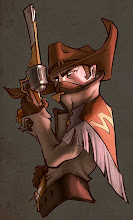
I did some fan TF2 concepts. Hopefully you can read the text. Eric Wolfpaw is coming to NYU, but they didn't book a room large enough (or I didn't rsvp quickly enough) so I can't go. Bummer.
Latest still life. Need to stop being lazy about these and actually flesh them out.
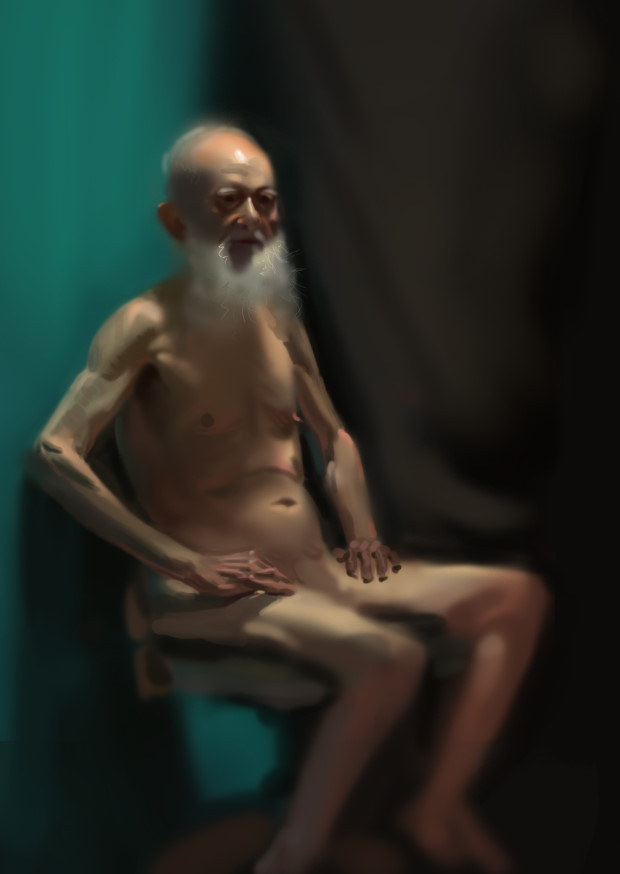
Old man still life. Did this at Frank Stockton's meetup. Guy's got mad skills and really good advice. If you live in NYC, you should find him on meetup.com and attend.
Think that's all for now. Will update more once I figure out what's going on with my life.
More on that later. For now, let's compile everything I've learned over the last three weeks.
You gotta let a story write itself, same way you gotta let a picture draw itself. You can't force creativity.
You can never accomplish something great without believing that you're special, or better than other people, because other people and circumstances will always lead you to believe that it can't be done, and you have to be able to ignore them. The first step to greatness is believing in yourself: "other people failed here, but I can succeed."
People who draw realistically often don't have the graphic design sensibilities of people who draw in their own style, and stylized art usually lacks the fundamentals of realism.
You have to know which parts of your painting are gonna POP with value contrast and edges. It's less about the shapes themselves, but more about the connections and relationships between them: edges.
Don't max out on saturation. Sneak up on it.
Warp a painting to get rid of tangents and make the drawing more interesting.
Frequency of detail brings objects forward.
Let accidents fill the gaps in information that exist outside the focal points. Your painting is a web.
Studies make you aware of how much information you can leave out in order to have something read. Painting from imagination is about arranging that information in a pleasing manner.
Learning new things gives me a high.
The more you iterate, the more ideas present themselves. Accidents make innovation.
Never bring in a new colour or material unless you can use it in more than one place on your piece.
Hard shadows and highlights define form more efficiently than careful shading in the light.
You can make anything you want read with just reflected and ambient light, however you should strive to do so with key light and shadow.
All ideas that you throw away should be good. The reason you're throwing them away is that they don't fit your project.
There are three crucial things to having the fire:
- Deadlines
- Feedback loop of achievement and satisfaction with your work
- Truly believing that you will achieve your goal
Your "skill" as a painter never really improves. Your perception of the world, though, does.
The importance of surfaces is prioritized by the angle at which they face the light. Thus, surfaces that are more important will be brightest.
You can often raise or lower your values by changing hue. Likewise, you can change the colours of the paint on the canvas by putting down colours outside of that hue family.
You cannot create in abstraction. You need constraints. Rules are prompts. Prompts make you think.
The motivations for the actions of your characters will determine the moral of your story.
When you're young, usually you are focused on the social aspects of life, which is funny, because very few people have achieved anything of merit. Then, when you're older and meet people that have gotten somewhere, you have no time to hang out with them, because you're too busy getting somewhere yourself.
What you're doing with lines is creating the silhouettes of things. Same with brushstrokes, but less prominently.
Iterations allow you to re-formalize your ideas, kind of like defragging an HD.
The worst enemy of the creative process is the illusion of completion. That is why iterations are so hard, but so necessary.
In the same way that every painting is an opportunity to find "truth," you have to follow your drawing to whatever you start "seeing." You search for lines that make you see what you're drawing, and follow those to the end project. You can't force your drawing to become what you originally intended it to be.
Thumbnailing characters is iterating graphical patterns on your "skeleton," the body.
Evaluate what qualities make it a crab. How long does it take to read as a crab and what information are you looking at to make the judgment? Reddish pale colours, intricate symmetrical patterns. Shapes - claw + legs. Think how much information you can leave out before it is no longer a crab!
Evaluate the hierarchy of information you take in.
Kenneth Branagh meditates at the beginning and end of each day. True fact.
Anything can be accomplished at a cost. When you're low on time, you can sacrifice other things.
And now, the work.
I did some fan TF2 concepts. Hopefully you can read the text. Eric Wolfpaw is coming to NYU, but they didn't book a room large enough (or I didn't rsvp quickly enough) so I can't go. Bummer.
Latest still life. Need to stop being lazy about these and actually flesh them out.
Old man still life. Did this at Frank Stockton's meetup. Guy's got mad skills and really good advice. If you live in NYC, you should find him on meetup.com and attend.
Think that's all for now. Will update more once I figure out what's going on with my life.
Tuesday, April 5, 2011
Who do you think you're fooling now?
It's such an ordeal to update this blog/sketchbook, but you know what? Someday, when I'm really good, some kid who's just starting to draw will want to scroll back all the way to now to see how I got to where I will be.
This thing calibrates my Monitaur, but it does a terrible job so I've been putting off making a still life out of it. Unfortunately, I'm running out of interesting objects to draw so there.
And then I did some fan art for Riot Games. It's their latest champion. That company is going far, because they're actually innovating within the DotA genre, and their business model is very clever. That is, until Valve gets on the scene with DotA 2. Then all those companies (all two of them) are getting hit by a freight train, unless Riot makes some really bold moves.
Some things I learned:
You compose with gradations, not flat colour. Always know where your gradations are going, and how intensely.
The most efficient way to make something better is to erase it. So do that as often as you can manage. Ideally, if you have the time and are willing to 'scrap' hours of work, you should do your illustration 3 times before the deadline. Good product is made by having smarter than average people iterate on an idea more than the competition.
Sometimes seeking shortcuts for processes actually takes longer than doing it the "stupid" way.
Next time you listen to a pop song, in your head replace all the "baby" lyrics with "hitler." It's the way it was meant to be heard.
I'm beginning to understand that more and more things in life depend on what you believe rather than logical analysis. There are many things you couldn't possibly figure out the reason for, so you have to rationalize it with your own belief. Fill in the gap in knowledge, in a way. So what you put in that gap is entirely up to you and sometimes it's very important to your attitude and work output. Please, always believe the most positive thing. If a big shot artist doesn't respond to your e-mail, don't blame the fact that your art isn't good, or that you came on too strong. Analyze what you can, then rationalize it with "he would have loved to answer if he wasn't so busy."
That said, in any past circumstance, there is always a more positive outcome that you could have achieved. You have to question how you could have gotten there, without regretting that you didn't.
I heard that the final boss of Diablo 3 is, in fact, Lady Gaga, and not the lord of terror.
Edges are gestalt psychology at work. When you draw from life, you find out how your brain makes sense of your scene, by analyzing which edges in it seem hard and which seem soft. The fast your eyes skim over the edge as you're looking at the scene, the softer that edge will be in your painting.
When doing something artistic, you gotta genuinely love what you do, so that you get some creativity help from your subconscious. When doing other tasks, like programming, you just have to have a passion for problem solving.
There are really 3 types of edges in digital painting. Hard, soft and textured. You can use a texture brush to softer things, instead of the boring old airbrush.
I also heard that in the Diablo movie the monk will be played by Vin Diesel.
This thing calibrates my Monitaur, but it does a terrible job so I've been putting off making a still life out of it. Unfortunately, I'm running out of interesting objects to draw so there.
And then I did some fan art for Riot Games. It's their latest champion. That company is going far, because they're actually innovating within the DotA genre, and their business model is very clever. That is, until Valve gets on the scene with DotA 2. Then all those companies (all two of them) are getting hit by a freight train, unless Riot makes some really bold moves.
Some things I learned:
You compose with gradations, not flat colour. Always know where your gradations are going, and how intensely.
The most efficient way to make something better is to erase it. So do that as often as you can manage. Ideally, if you have the time and are willing to 'scrap' hours of work, you should do your illustration 3 times before the deadline. Good product is made by having smarter than average people iterate on an idea more than the competition.
Sometimes seeking shortcuts for processes actually takes longer than doing it the "stupid" way.
Next time you listen to a pop song, in your head replace all the "baby" lyrics with "hitler." It's the way it was meant to be heard.
I'm beginning to understand that more and more things in life depend on what you believe rather than logical analysis. There are many things you couldn't possibly figure out the reason for, so you have to rationalize it with your own belief. Fill in the gap in knowledge, in a way. So what you put in that gap is entirely up to you and sometimes it's very important to your attitude and work output. Please, always believe the most positive thing. If a big shot artist doesn't respond to your e-mail, don't blame the fact that your art isn't good, or that you came on too strong. Analyze what you can, then rationalize it with "he would have loved to answer if he wasn't so busy."
That said, in any past circumstance, there is always a more positive outcome that you could have achieved. You have to question how you could have gotten there, without regretting that you didn't.
I heard that the final boss of Diablo 3 is, in fact, Lady Gaga, and not the lord of terror.
Edges are gestalt psychology at work. When you draw from life, you find out how your brain makes sense of your scene, by analyzing which edges in it seem hard and which seem soft. The fast your eyes skim over the edge as you're looking at the scene, the softer that edge will be in your painting.
When doing something artistic, you gotta genuinely love what you do, so that you get some creativity help from your subconscious. When doing other tasks, like programming, you just have to have a passion for problem solving.
There are really 3 types of edges in digital painting. Hard, soft and textured. You can use a texture brush to softer things, instead of the boring old airbrush.
I also heard that in the Diablo movie the monk will be played by Vin Diesel.
Sunday, March 13, 2011
Missing Deadlines
For the past three still lives I've used pretty much completely different methods of starting. First one was an amalgamation of brushes, just getting warmed up. Next, I tried to block everything in with a hard brush and exact colours. Now I tried blocking in with a soft round airbrush and approximate everything, then refine colours, edges, values and drawing as you go along. I think this is the method that saves you the most time in the end. You can leave most of your painting with soft edges and "averaged" colour, but then tighten up the areas of focus, and find a way to guide the eye creatively. The danger here is it's very easy to make the entire painting swim in mud.
I've also been thinking a lot about colour transitions, and trying to make them as efficiently as possible. Highlights, for example, take at least two tones (usually a saturated soft one first, then a dull, bright, hard stroke on top) to pull off. I think ideally you want to simplify the picture down to as few colours as possible, and still retain all the information in the picture. That's where the "skill" comes in.
Thursday, March 10, 2011
Daily Still Life: Start!
Well, it's time to get back to work, and I figure the only WEI I'm gonna beat Wei Wang at art is to paint from life. That's the wei everyone seems to learn how light works and how to create believable form. So, until Daily Duels gets back on its feet, here come the daily still lives!
Still need to work on values and texture. It's pretty tough, but I figure these will get much easier in about a week.
Then there are these guys:
Still need to work on values and texture. It's pretty tough, but I figure these will get much easier in about a week.
Then there are these guys:
The trouble with that portfolio below is that I'm a lot better than it, both because the 2D works are now almost a month old, and because I did each one in a day. But nevermind that, the project I'm working on right now is gonna kick so much ass, you have no idea. I hope to finish it by Monday.
Monday, October 25, 2010
Not Painting
I resolved to only do errands when I'm too tired to paint. I spend way too much time doing useless crap like washing dishes and doing laundry.
Monday, October 18, 2010
Grinding Gears
The past two weeks have been extremely eventful. Now it's time to get back to studies, life drawing/painting in preparation for illuxcon.
My still life always looks darker when I upload it. I guess it's time to re-calibrate my minotaur.
Monday, September 27, 2010
Lofty Aspirations
Welcome to Manton, random Chinese dude. I appreciate your support.
I like digital paintings that resemble traditional mediums because you can see the artist's skill through how much information is transmitted in each stroke. Anyone can sit there and render until it looks like the model they used for 'reference.'
This took about an hour, mostly because of drawing issues.
I like digital paintings that resemble traditional mediums because you can see the artist's skill through how much information is transmitted in each stroke. Anyone can sit there and render until it looks like the model they used for 'reference.'
This took about an hour, mostly because of drawing issues.
Sunday, September 19, 2010
Paint-in-your-underwear-all-day Chalet
If you work on a problem long enough, the solution will present itself.
We are choosing to enjoy two or three experiences at a time. As I am writing this, I am also eating a salad. Plus I may remember to text somebody or to vacuum the floor, and as we all know it takes five minutes to get back to any task after being interrupted. The more things you choose to do at once, the more shallow your experiences will be, let alone how tasking it is on your mind. It might seem like you get more done, but personally I've noticed that the stupid mistakes I make because of multitasking eat up all the time I might have saved. I prefer to live a fulfilling life, in which you use your full attention to experience the now, however I can't bring myself to live that way. Efficiency is too deeply ingrained in my brain.
You can also gather unrelated reference for shape language ideas.
Exaggeration in drawing is just another trick for seeing form. Once you amass enough of those tricks, you can keep your brain away from relaxing into "regular" seeing mode for long enough to complete the image.
These are from the past two days. The reason my updates have been slacking...will be unveiled soon.


We are choosing to enjoy two or three experiences at a time. As I am writing this, I am also eating a salad. Plus I may remember to text somebody or to vacuum the floor, and as we all know it takes five minutes to get back to any task after being interrupted. The more things you choose to do at once, the more shallow your experiences will be, let alone how tasking it is on your mind. It might seem like you get more done, but personally I've noticed that the stupid mistakes I make because of multitasking eat up all the time I might have saved. I prefer to live a fulfilling life, in which you use your full attention to experience the now, however I can't bring myself to live that way. Efficiency is too deeply ingrained in my brain.
You can also gather unrelated reference for shape language ideas.
Exaggeration in drawing is just another trick for seeing form. Once you amass enough of those tricks, you can keep your brain away from relaxing into "regular" seeing mode for long enough to complete the image.
These are from the past two days. The reason my updates have been slacking...will be unveiled soon.

For your benefit, the previous Hogarth (9 days ago):
And now, colour keys from your favorite motion picture. I blame all errors on poor DVD quality and screen glare.

Wednesday, September 15, 2010
Take It In Stride
Aside from your jeans, the only reason you're smarter than other people is the fact that when you were a kid you asked more "why" questions than necessary. Don't ask too many questions. If you look far enough ahead, nothing is worth doing because you deprive yourself of the journey and get to the end result, the effect of which will shortly wear off.
Also, empty your mind and be like water. Last one messed up by my laptop monitor.
Friday, September 10, 2010
Subscribe to:
Posts (Atom)