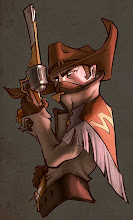
Sorry I've been away, everyone. Things are getting progressively busier and busier, but it's all good because I'm happily employed at Riot Games as an associate concept artist! I'm living with my friend in fumy downtown Los Angeles trying to find a place to live in sunny Santa Monica, where my beloved studio is.
Consider this a rough step-by-step tutorial of how to break into the industry based on my experience, the mistakes I made and the things I learned along the way - while they are fresh in my mind. Anyone listening to my story should know that since it already happened, by repeating the same process you won't be able to get the same results. You will need to work harder, because I just took your spot.
Now, the big dogs out there will have much more information about the industry, how it works and what they like to see. I'm simply attempting to sum up how I would approach it if I had 5 years to do it over.
Step 1:
Don't go to college. I make less in a year than my tuition was for one semester, which is enough to live decently in Santa Monica, one of the most desirable areas in Los Angeles. While the place I got educated was a lot of fun, a fulfilling life experience, and got me a piece of paper that helped me get the job and stay in the States (I'm Canadian), it didn't do me much good as far as furthering my drawing skills. In fact, it took away time that I could have spent getting better.
Step 2:
Move in with an ambitious art buddy. It is very hard to motivate yourself when you are living on your own, or with your parents. It is even harder when all your roommates want to do is kick back and have fun. If you're serious about drawing for a living, you don't have time for fun right now. Get rid of friends, girlfriends, family, drugs, video games and whatever other distractions may stand in your way. Your ambitious art buddy will satisfy all your social needs and motivate you. Get someone around your skill level, where neither of you may feel superior to the other, so you will both take each others' criticism.
I lived with Neolight from last September to May. He is now going through an art internship at Insomniac Games.
Step 3:
Use the money you saved from not going to college to sustain yourself. Join a gym. Eat healthy. Sleep well. I can't emphasize this enough. If you don't exercise every day, you raise the risk of getting carpal tunnel or other RSI's. Alternatively, if you don't run into physical problems from drawing, you're not drawing enough. When you run into wrist/back problems, you'll need to carefully analyze your posture and drawing methods. Leading a healthy lifestyle outside of drawing will help you, but you'll also need to take frequent stretch breaks, have an ergonomic set-up for drawing, and do anything you can to adjust the physical act of drawing so that you don't get put out of commission by RSI. When I go to life drawing, I don't do bold strokes that carve the form out of the page anymore, because I only have about 400 of those in me before my thumb begins to hurt. Instead I draw lightly, bringing the form out with gentle strokes that I can do all day.
Step 4:
Communicate with other artists. You're not going to learn enough about the industry or about art from the internet alone. Reach out to as many people as you can and try your best to soak up everything they tell you. E-mailing people and going to conventions has countless benefits. It raises the industry's awareness of you, it gets you super inspired, builds up your social network (which increases opportunities), gets you tons of new information - anecdotes like this one, critiques on your work, etc etc. Face time with other artists is key. It puts you in the right mindset and reminds you that you're not alone on this journey.
Note: The only way you can increase the chances of people responding to your e-mails is by being yourself and being honest. If they still don't respond, then they're either way too busy to read them, or you shouldn't hear their feedback anyway.
Step 5:
Have something that separates you from hundreds of other kids at your skill level or better, trying to get your job . Concept artists are a dime a dozen. Even if you're not at a skill level comparable to the big stars of the industry, being able to do one thing exceptionally well will really increase your chances of getting hired (especially if that thing is in demand). This could be a tangible skill, a style that you have developed, subject matter you specialize in, or just a je-ne-sais-quoi about your work that makes other people remember it. I am good at turnarounds.
Step 6:
Get lucky. I did a turnaround to cover my bases, and 6 months later I happened to show it to Riot at precisely the right time when they needed someone with this skill. At this point, Riot's sky-rocketing reputation has turned the heads of badasses way beyond my level and I highly doubt I'd be able to get in if I were to apply now. Be at the right place at the right time, and seize any opportunity that comes your way. I had no idea how awesome Riot was when I was showing my portfolio to them. They were just across the way from the Blizzard booth at GDC.
Step 7:
Have a loftier goal that getting a job in the industry. It's a good place to start, but once you do achieve it, you'll need a new place to get to. Only recently did I understand that the journey is more fun than the destination, so I have to come up with a new goal fast, because I've trained my mind to focus on the task at hand and give it my all. At the moment, my brain is very confused as to what to focus on, and you don't want that to happen.
I'm attaching some life drawing for good measure. I haven't done it in a while, but I was sitting behind a dude who was just so good, that I had a really easy time simplifying the figure after looking at his drawings. 2-25's.
Monday, August 1, 2011
Wednesday, June 15, 2011
New Developments
Almost there, gotta stay on target. I'm gonna switch to Loomis studies from now on. If I decide to do them digitally, you'll be seeing them.
Every final stroke you leave on the canvas should be hand-mixed, not picked from the canvas.
You have to observe the hierarchy between the most important colours/values when doing a study. Put the most important ones down first.
If you mix the wrong value of a colour and you need to "transpose" it higher or lower, don't forget to adjust the saturation accordingly. It rarely stays the same when you make a colour lighter or darker.
When you can't quite mix the right colour, make a light stroke erring on one side of that colour, then make another light stroke erring on the other side. As in, if the colour you pick first is too blue, move the slider a tiny bit towards yellow, and make another light stroke. Mix on the canvas.
When you're nervous, you try to prevent your brain from analyzing yourself into oblivion. You talk fast, make a lot of random movements, eyes dart around, breathe quickly etc. So the way to not be nervous is to stop the analysis. Somehow. That's hard.
As artists get bigger, more and more people compete for getting in touch with them. How do you win?
- Start early
- Have something to offer
- Never think that you're beneath somebody, but be humble instead.
Always find a positive justification for what you're doing, even if it's not entirely true. Then make it true. If you can't do that, then don't do it.
Let it be. Do your own thing. Be tolerant and respectful of others, even if you can't find anything to respect them for.
Only after you have experienced the horror of the worst case scenario are you able to judge things rationally.
If there is enough information, reasoning will be productive. Otherwise it will be emotional and negative.
Assuming your aim is to get better, every time you give yourself to something and it looks like crap, you have done the right thing. The trouble is, if your work looks like crap all the time, you don't want to do it at all. But you have to keep going.
Everyone is too busy playing their own game to notice how you're playing yours.
When blocking in, don't try to put down exactly the colour you see from the start. Put down the jumping off colour, i.e. what you're gonna mix all the hues and variations from.
Every final stroke you leave on the canvas should be hand-mixed, not picked from the canvas.
You have to observe the hierarchy between the most important colours/values when doing a study. Put the most important ones down first.
If you mix the wrong value of a colour and you need to "transpose" it higher or lower, don't forget to adjust the saturation accordingly. It rarely stays the same when you make a colour lighter or darker.
When you can't quite mix the right colour, make a light stroke erring on one side of that colour, then make another light stroke erring on the other side. As in, if the colour you pick first is too blue, move the slider a tiny bit towards yellow, and make another light stroke. Mix on the canvas.
When you're nervous, you try to prevent your brain from analyzing yourself into oblivion. You talk fast, make a lot of random movements, eyes dart around, breathe quickly etc. So the way to not be nervous is to stop the analysis. Somehow. That's hard.
As artists get bigger, more and more people compete for getting in touch with them. How do you win?
- Start early
- Have something to offer
- Never think that you're beneath somebody, but be humble instead.
Always find a positive justification for what you're doing, even if it's not entirely true. Then make it true. If you can't do that, then don't do it.
Let it be. Do your own thing. Be tolerant and respectful of others, even if you can't find anything to respect them for.
Only after you have experienced the horror of the worst case scenario are you able to judge things rationally.
If there is enough information, reasoning will be productive. Otherwise it will be emotional and negative.
Assuming your aim is to get better, every time you give yourself to something and it looks like crap, you have done the right thing. The trouble is, if your work looks like crap all the time, you don't want to do it at all. But you have to keep going.
Everyone is too busy playing their own game to notice how you're playing yours.
When blocking in, don't try to put down exactly the colour you see from the start. Put down the jumping off colour, i.e. what you're gonna mix all the hues and variations from.
Friday, June 10, 2011
Keeping Up
For various reasons, I've abandoned certain studies you'll see below. Most of them because of my environment, i.e. lighting changed or it was too hot to continue. The woes of painting. Anyway.
When you use RGB sliders you choose your ultimate hue based on ratios of the 3 colours, not the individual values of them. Thus, the hue shifts mure more drastically amidst desaturated colours, because there is less of it to go about. That's why the colour wheel is smaller in the middle, where the saturation is less.
The colour of the shadow depends on what's bouncing light into it!! It's amazing how long it took me to get this.
Hardness or softness of the edge of your brush will affect your colour choices. You can be a lot more radical with your colour picking with an airbrush. Hard-edged strokes need to adhere very closely to the colour scheme and to the adjacent colours.
Drawing is, in a way, a release of aggression. All the things we suppress in civilized society find their way out onto a piece of paper.
New technique here. Picked all the colours myself and used a hard brush. Didn't mix anything. Really good practice!
When you use RGB sliders you choose your ultimate hue based on ratios of the 3 colours, not the individual values of them. Thus, the hue shifts mure more drastically amidst desaturated colours, because there is less of it to go about. That's why the colour wheel is smaller in the middle, where the saturation is less.
The colour of the shadow depends on what's bouncing light into it!! It's amazing how long it took me to get this.
Hardness or softness of the edge of your brush will affect your colour choices. You can be a lot more radical with your colour picking with an airbrush. Hard-edged strokes need to adhere very closely to the colour scheme and to the adjacent colours.
Drawing is, in a way, a release of aggression. All the things we suppress in civilized society find their way out onto a piece of paper.
New technique here. Picked all the colours myself and used a hard brush. Didn't mix anything. Really good practice!
Saturday, June 4, 2011
Friday, June 3, 2011
Thursday, June 2, 2011
Love Doctors
I'm finally alive and online, and man, did I miss the boat of getting good! About two years ago tons of people on CA got good, posted in each others' sketchies and got awesome jobs, including Dave Rapoza, Algenpfleger, Danielc, Miles etc etc. Too bad I had to go to film school and learn about nothing that had to do with painting for another year. Oh well. Maybe the boat will come again...
Wednesday, June 1, 2011
PIcking Up the Pace
Dark objects have less value variation in light. I expected more insights from all the studies I've been doing. I guess my life is too stressful for insights right now.
Subscribe to:
Posts (Atom)